


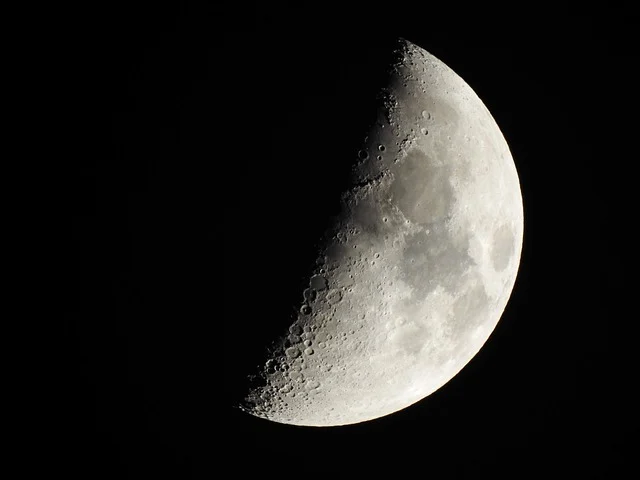
Photo: Kanenori / Pixabay
Hijri years are shorter
The Islamic (Hijri) calendar follows the moon. Each month begins with a new crescent and lasts 29 or 30 days, and a year of 12 months averages about 354.37 days. The Gregorian year follows the sun and lasts 365.24 days, so a Hijri year is about 11 days shorter. That is why your age in Hijri years is always a little higher than your usual age: about one extra year for every 33 years of life.
How the calculator works
Your browser converts your date of birth and today’s date into the Umm al-Qura calendar, the official Hijri calendar of Saudi Arabia, which is computed in advance from astronomical rules. The calculator then counts complete Hijri years, complete Hijri months and the remaining days — exactly as an age in the Gregorian calendar is counted, but with lunar months. It also shows your age as a decimal number of Hijri years (days lived ÷ 354.367) and the date of your next Hijri birthday.

A worked example
Someone born on 15 May 1990 was born on 20 Shawwal 1410 AH. On 22 October 2026 (11 Jumada I 1448) they are 36 in Gregorian years but 37 years, 6 months and 21 days in Hijri years. Their next Hijri birthday, 20 Shawwal 1448, falls on 28 March 2027 — when they turn 38 in Hijri years.
Moon sighting and one-day differences
Many countries and communities begin each Hijri month when they actually see the new crescent, so their dates can differ from Umm al-Qura by a day. That can shift a Hijri birthday by a day but changes an age by one day at most. For religious dates, follow the announcement of your local authority.
Dates far in the past
Browsers use the published Umm al-Qura tables from 1300 AH (1882) onwards; for earlier dates they fall back to a standard arithmetic Islamic calendar, which can differ by a day or two. Dates of birth from 1900 onward are fully covered.
Private by design
Your device converts everything using its built-in calendar data; you send nothing to us. For the moon phase on the day you were born, see moon on my birthday, and for your age in Gregorian years, months and days, use the main age calculator.

Steps to Calculate Your Hijri Age
Using the Hijri age calculator is straightforward. First, locate the input field for your date of birth. This field typically defaults to the current date. Therefore, you must change it to your specific birth date.
Next, input your Gregorian date of birth. Select the day, month, and year from the provided calendar interface. Ensure the date is accurate to avoid errors in your age calculation. The calculator automatically processes your input as you make your selections.
Finally, review the displayed results. The calculator will show your age in complete Hijri years, months, and days. It also provides your exact Hijri date of birth and the Gregorian date of your upcoming Hijri birthday. This makes tracking your lunar age simple and quick.
Interpreting Your Hijri Age Result
The calculator provides several pieces of information. Your primary result is your age in Hijri years, months, and days. This represents the total duration from your birth date to the current date, measured in the Islamic calendar system. Remember, Hijri years are shorter than Gregorian years, so this age will be numerically higher.
Furthermore, the result includes your Hijri date of birth. This conversion from your Gregorian birth date is fixed. It allows you to know your original birth date within the Islamic calendar. This specific date remains constant each year.
Lastly, the calculator shows your next Hijri birthday. This is the Gregorian date on which your next Hijri age milestone occurs. Because the Hijri year is shorter, this date shifts earlier in the Gregorian calendar each year. This helps you anticipate upcoming Hijri celebrations.
When Other Methods May Be Better
The Hijri age calculator uses the Umm al-Qura calendar. This is a computed calendar, meaning its dates are fixed based on astronomical calculations. It provides a consistent and widely accepted standard for general purposes and civil records. However, some communities use different methods.
Many religious observances depend on local moon sighting. This means people determine the start of a new month by physically observing the new crescent moon. Consequently, dates based on moon sighting can differ by a day or two from Umm al-Qura dates. For religious matters, always follow your local authority's announcements.
Therefore, while the calculator gives an accurate age based on the Umm al-Qura system, it may not align perfectly with every community's specific observed Hijri dates. If precision for religious events is paramount, consult local Islamic scholars or religious councils.
Frequently asked questions
Why is my Hijri age higher than my normal age?
A Hijri year has 12 lunar months, about 354 or 355 days — roughly 11 days shorter than a solar year. So more Hijri years fit into the same time: your Hijri age is about 3% higher, roughly one extra year for every 33.
Which Hijri calendar does the calculator use?
The Umm al-Qura calendar of Saudi Arabia, the calendar built into modern browsers. Countries that start months by local moon sighting can be a day earlier or later.
What is my Hijri date of birth?
The calculator shows it under the result — for example, 15 May 1990 was 20 Shawwal 1410 AH.
When is my Hijri birthday?
On the same Hijri day and month each Hijri year. Because the Hijri year is shorter, it moves about 11 days earlier in the Gregorian calendar every year. The calculator shows the next one.
Sources