
In this article
The winter solstice 2026 (northern hemisphere) is on 21 December at 20:50 UTC. The equinox and solstice dates for 2027 are: March equinox on 20 March, June solstice on 21 June, September equinox on 23 September, and December solstice on 22 December (UTC). See the table for exact times. Also, a calculator counts days to any of them.
Days until the next equinox and solstice dates
Exact dates and times (UTC)
| Event | 2026 | 2027 | 2028 |
|---|---|---|---|
| March equinox | 20 Mar, 14:45 | 20 Mar, 20:24 | 20 Mar, 02:17 |
| June solstice | 21 Jun, 08:25 | 21 Jun, 14:10 | 20 Jun, 20:01 |
| September equinox | 23 Sep, 00:05 | 23 Sep, 06:01 | 22 Sep, 11:45 |
| December solstice | 21 Dec, 20:50 | 22 Dec, 02:42 | 21 Dec, 08:20 |
Times are calculated with the open-source Astronomy Engine library. This agrees with the US Naval Observatory to within about a minute. Times are in UTC (the same as GMT).
Understanding the Astronomical Definitions
An equinox or solstice marks a precise astronomical moment. These events are not tied to a full day. Instead, they represent the Earth’s specific position in its orbit around the Sun relative to its axial tilt.
- Equinox: The moment when the Sun crosses the celestial equator. At this instant, the Earth’s axis is neither tilted towards nor away from the Sun. Day and night are nearly equal in length across the globe.
- Solstice: The moment when the Sun reaches its highest or lowest point in the sky at noon, as seen from the Earth. This corresponds to the Earth’s maximum axial tilt towards or away from the Sun. It results in the longest or shortest day of the year.
These definitions are crucial for understanding why we track exact times. A difference of a few hours can mean a different calendar date in another time zone.
Why the date depends on where you are
A solstice or equinox is a single instant for the whole planet, so its local date depends on your time zone. The December 2027 solstice, at 02:42 UTC on 22 December, falls on:

- 21 December in New York (21:42 EST) and Los Angeles (18:42 PST);
- 22 December in London (02:42), Karachi (07:42), Delhi (08:12), Tokyo (11:42) and Sydney (13:42 AEDT).
Likewise the March 2027 equinox, at 20:24 UTC on 20 March, is already 21 March in Pakistan, India, Iran and everywhere east — which is why the Persian New Year, Nowruz, starts on 21 March 2027 (see the Persian calendar).
How to Convert UTC to Your Local Time
Converting UTC to your local time zone is a straightforward process. You need to know your time zone’s offset from UTC.
- Find the UTC time: This article provides all dates and times in UTC.
- Determine your local time zone offset: For example, New York uses Eastern Standard Time (EST), which is UTC-5. London uses Greenwich Mean Time (GMT), which is UTC+0 (same as UTC). Tokyo uses Japan Standard Time (JST), which is UTC+9.
- Add or subtract the offset:
- If your time zone is UTC+X, you add X hours to the UTC time.
- If your time zone is UTC-X, you subtract X hours from the UTC time.
- Adjust the date if necessary: If adding or subtracting hours crosses midnight, the local date will change.
Worked Example: June Solstice 2028 in Los Angeles
Let’s use the June solstice 2028 as an example. The table shows it occurs on 20 Jun, 20:01 UTC.
- UTC time: 20:01 on June 20, 2028
- Los Angeles time zone: Pacific Daylight Time (PDT) is UTC-7 during summer months.
- Calculation: 20:01 UTC – 7 hours = 13:01 PDT.
- Local date: Since we did not cross midnight, the date remains June 20.
So, for someone in Los Angeles, the June solstice 2028 is at 13:01 PDT on June 20.
Why the dates shift from year to year
The solar year lasts about 365.2422 days. Calendar years have 365 or 366 days. Each solstice comes roughly 6 hours later annually. A leap day then pulls it back almost a full day. The June solstice falls on June 21 in 2026 and 2027. It falls on June 20 in 2028, a leap year. Gregorian leap-year rules keep the equinox and solstice dates within a two- or three-day window.
The Earth’s Tilt and Orbit: The Root Cause
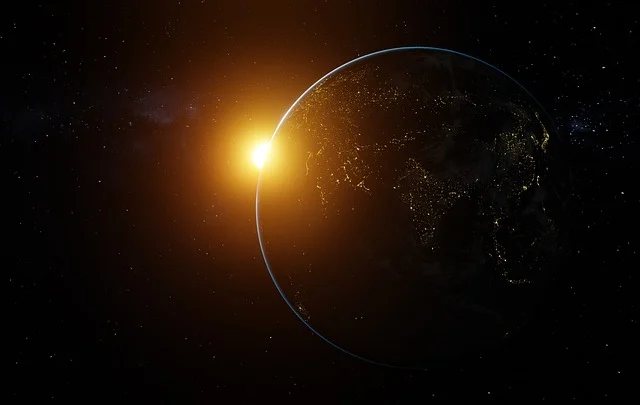
The Earth’s axis is tilted approximately 23.5 degrees relative to its orbital plane around the Sun. This tilt is the primary reason we experience seasons and why solstices and equinoxes occur. As the Earth orbits the Sun, different parts of the planet receive more direct sunlight at different times of the year.
- Solstices: Occur when one of the Earth’s poles has its maximum tilt toward or away from the Sun. This leads to the Sun appearing directly overhead at either the Tropic of Cancer (June solstice) or the Tropic of Capricorn (December solstice).
- Equinoxes: Occur when the Earth’s axis is perpendicular to the Sun’s rays. The Sun appears directly over the Equator.
The elliptical shape of Earth’s orbit also plays a minor role, causing slight variations in orbital speed. However, the axial tilt is the dominant factor for seasonal changes.
What happens at each one
| Event | Northern hemisphere | Southern hemisphere | What the sun does |
|---|---|---|---|
| March equinox | Spring begins (astronomical) | Autumn begins | Crosses the equator heading north |
| June solstice | Longest day; summer begins | Shortest day; winter begins | Overhead at the Tropic of Cancer |
| September equinox | Autumn begins | Spring begins | Crosses the equator heading south |
| December solstice | Shortest day; winter begins | Longest day; winter begins | Overhead at the Tropic of Capricorn |
At the equinoxes, day and night are nearly equal everywhere. Day is a few minutes longer than 12 hours. The sun’s disc is not a point. The atmosphere bends its light. Sunrise comes a little early, and sunset a little late. The date of exactly equal day and night, called the equilux, comes a few days before the March equinox. It comes a few days after the September one. These facts are relevant to understanding equinox and solstice dates.
Common Misconceptions and Clarifications
- “Equal day and night at the equinox”: While often stated, it’s not perfectly true for the reasons mentioned (Sun’s disc, atmospheric refraction). The equilux accounts for these factors.
- “The Sun is closer to Earth in summer”: This is a common misconception. Our planet is actually furthest from the Sun (aphelion) around the June solstice and closest (perihelion) around the December solstice. The tilt of the Earth’s axis, not distance, causes seasons.
- “Solstice means the Sun stands still”: The word “solstice” comes from Latin “sol” (sun) and “sistere” (to stand still). This refers to the apparent standstill of the Sun’s path across the sky before it reverses direction. It does not mean the Earth stops moving.
Astronomical vs meteorological seasons
Astronomers start seasons using equinox and solstice dates. Weather services use meteorological seasons. These start on the first day of a month. Spring begins March 1. Summer starts June 1. Autumn begins September 1. Winter starts December 1 (northern hemisphere). Whole months make temperature records easier to compare. Thus, “the first day of summer is June 1” is correct. Also, “the first day of summer is June 21” is correct. They use different definitions.

Why the Two Systems Exist
The two systems serve different purposes. Astronomical seasons precisely track the Earth’s position in its orbit. This is useful for scientific understanding of celestial mechanics and for cultures that align festivals with these exact moments.
Meteorological seasons simplify data collection and comparison for weather and climate. Dividing the year into three-month calendar blocks helps meteorologists. They more easily track temperature trends and precipitation. This approach is more practical for forecasting and agricultural planning than using equinox and solstice dates.
How long is the longest day?
Day length depends on latitude. At the equator, day length hardly changes all year. In London, the longest day is about 16 hours 38 minutes. The shortest is about 7 hours 50 minutes. North of the Arctic Circle, the sun does not set around the June solstice. Even with equinox and solstice dates, the earliest sunset comes before the December solstice. The latest sunrise comes after it. This happens because of Earth’s tilt and oval orbit.

Daylight Hours and Latitude: A Closer Look
The further you are from the equator, the more dramatic the change in day length between solstices. This is directly due to the Earth’s axial tilt.
- Equator (0° latitude): Experiences roughly 12 hours of daylight year-round. The Sun’s path changes little.
- Temperate Zones (e.g., London 51°N): See significant variations. The Sun rises higher and stays above the horizon longer in summer, and lower and shorter in winter.
- Polar Circles (66.5° N/S and beyond): Experience extreme variations. During their summer solstice, they have 24 hours of daylight (Midnight Sun). During their winter solstice, they have 24 hours of darkness (Polar Night).
The Equation of Time explains why the earliest sunset and latest sunrise do not align with the shortest day. This phenomenon also means the latest sunset and earliest sunrise do not align with the longest day. Earth’s axial tilt and elliptical orbit cause this. The Sun’s apparent position in the sky varies. This affects solar noon’s timing relative to clock time, differing from equinox and solstice dates.
Who This Information Does Not Suit
Near the equator, “longest day” or “shortest day” has little practical meaning. Daylight hours remain constant all year. The traditional four seasons are also less pronounced in these regions. Temperature and rainfall patterns define the climate more than equinox and solstice dates.
Celebrations
People have marked these days for thousands of years. Stonehenge in England is aligned with the midsummer sunrise and midwinter sunset, and thousands gather there for the June solstice. Midsummer is a major festival in Sweden and Finland; Nowruz marks the March equinox; Yalda Night in Iran marks the longest night; and the Chinese Dongzhi festival celebrates the December solstice. The dates of Easter, Holi and other spring festivals are also linked to the March equinox — see when is Easter and when is Holi.

Cultural Significance Through History
From ancient agricultural societies to modern spiritual groups, equinoxes and solstices have held deep cultural and spiritual meaning. They marked crucial turning points in the year for planting, harvesting, and preparing for colder months.
- Agricultural Cycles: Farmers relied on these celestial events to determine optimal times for crop cycles, directly impacting survival.
- Spiritual and Religious Observances: Many religions and spiritual traditions incorporate these dates. They symbolize renewal, death, rebirth, light, and darkness. For example, the alignment of ancient structures like Stonehenge or the Mayan pyramids demonstrates the profound importance these events held for early civilizations.
- Folklore and Mythology: Many myths and legends are tied to the changing seasons, the lengthening and shortening of days, and the power of the Sun.
Even today, these dates provide a connection to the natural world and the rhythms of our planet, inspiring celebrations and reflections across diverse cultures.
Frequently asked questions
When is the winter solstice 2026?
21 December 2026 at 20:50 UTC — 3:50 pm EST in New York and 1:50 am on 22 December in Pakistan.
When is the summer solstice 2027?
21 June 2027 at 14:10 UTC.
When is the spring equinox 2027?
20 March 2027 at 20:24 UTC, which is 21 March in Asia and Australia.
Is the solstice always on the 21st?
No. It can fall on 20, 21 or 22 June and 20, 21, 22 or 23 December, depending on the year and your time zone. This shift is due to the difference between the solar year and our calendar year, including the effect of leap years.
Why do we have equinoxes and solstices?
These events occur because the Earth’s axis is tilted approximately 23.5 degrees relative to its orbit around the Sun. As the Earth travels around the Sun, this tilt means different hemispheres receive more direct sunlight at different times, causing seasons, solstices, and equinoxes.
Sources
- US Naval Observatory: Earth’s seasons, equinoxes, solstices, perihelion and aphelion
- Astronomy Engine (open-source library used for the times above)
- Met Office: When does spring start? (meteorological vs astronomical)

Yasir Hafeez is the founder and editor of ItsAgeCalculator. He builds the calculators, writes and checks the guides and articles, and tests every result against fixed date rules. He also runs OmniMatrics, a site of everyday calculators and converters.